
JAK Inhibitors Compared: Upadacitinib vs Tofacitinib vs Baricitinib — Price and Use Differences
01 Aug, 2026
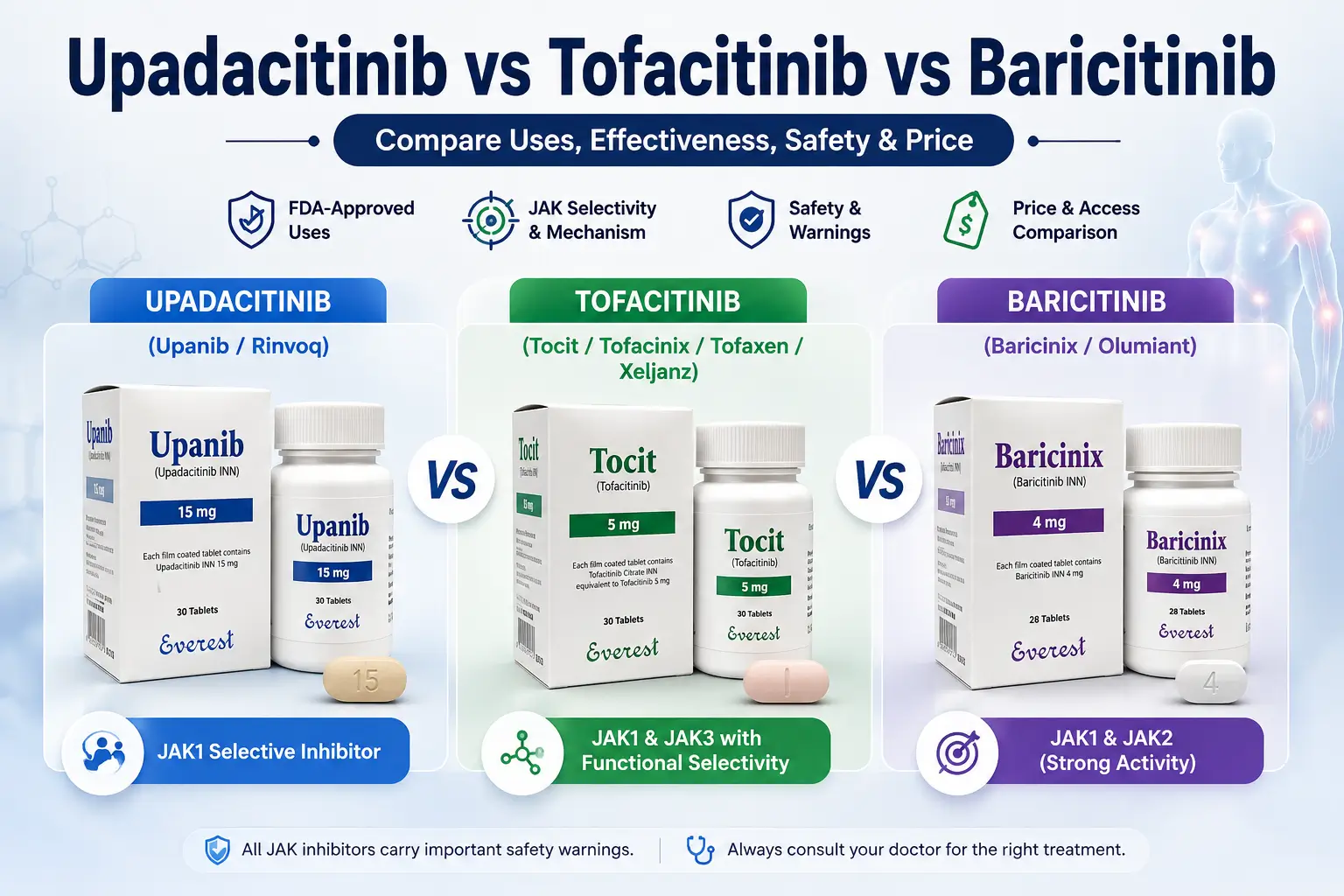
If you’re trying to make sense of upadacitinib vs tofacitinib vs baricitinib, you’re not alone. This upadacitinib vs tofacitinib vs baricitinib discussion comes up often because these medicines can treat similar immune-driven conditions, yet they differ in FDA-approved uses, JAK selectivity, safety warnings, and cost.
In this guide, I’ll walk you through upadacitinib vs tofacitinib vs baricitinib in plain language, with an easy JAK inhibitor comparison table and FDA-sourced indication details, plus a practical JAK inhibitor price comparison so you can have a clearer conversation with your clinician. (And yes, we’ll also touch on the common brand framing, Rinvoq vs Xeljanz vs Olumiant, since many people search that way when comparing upadacitinib vs tofacitinib vs baricitinib.)
Table of Contents
JAK inhibitors and cytokine signaling (simple explanation)
Your immune system uses chemical “messages” called cytokines to tell immune cells when to turn inflammation up or down. Those messages travel from the outside of a cell to the inside through a pathway that often relies on enzymes called Janus kinases (JAKs). When JAKs switch on, they trigger downstream signals (commonly via STAT proteins) that can increase inflammatory activity.
JAK inhibitors reduce that signaling, which can help calm inflammation in conditions like rheumatoid arthritis and certain skin or bowel diseases. This is the basic idea behind any JAK inhibitor comparison and why upadacitinib vs tofacitinib vs baricitinib is a meaningful clinical question.
Source: FDA labels for each product (mechanism section). (FDA: Drugs@FDA)
At-a-glance comparison table
The table below is meant to help you quickly compare upadacitinib vs tofacitinib vs baricitinib, including a simplified view of selectivity and a JAK inhibitor price comparison. Prices vary by dose, insurance, pharmacy, and assistance programs, so consider this a starting framework, not a final out-of-pocket quote.
| Drug (common name) | Active ingredient | JAK selectivity (per FDA labeling language) | FDA-approved uses (high level) | US price (typical) | Emergency Drug price | Site product | Site page |
| Upadacitinib | upadacitinib | JAK1 selective inhibitor (selectivity described in labeling) | Multiple immune-mediated indications (see FDA label) | Varies | Varies | Upanib | Upanib hub page |
| Tofacitinib | tofacitinib | JAK inhibitor (JAK1/JAK3 with functional selectivity; labeling describes activity) | Multiple immune-mediated indications (see FDA label) | Varies | Varies | Tocit / Tofacinix / Tofaxen | Tocit, Tofacinix, Tofaxen |
| Baricitinib | baricitinib | JAK inhibitor (prominent JAK1/JAK2 activity; labeling describes activity) | Multiple indications (see FDA label) | Varies | Varies | Baricinix | Baricinix hub page |
| Generic options | varies | varies | depends | varies | varies | Generic hub | Generic hub page |
Notes on the table: For the most accurate, current indication list and selectivity wording, always check the latest FDA Prescribing Information:
FDA-approved uses and selectivity
When people ask about upadacitinib vs tofacitinib vs baricitinib, they’re usually asking two things: “What is each one approved to treat?” and “How do they differ mechanistically?” Here’s the cleanest way to think about it using FDA labeling as the authority.
Upadacitinib is described in FDA labeling as a JAK inhibitor with greater inhibitory potency for JAK1 relative to JAK2/JAK3 (often summarized as a JAK1 selective inhibitor in common clinical language). Tofacitinib and baricitinib are also JAK inhibitors, but with different inhibitory profiles described in their respective labels. These differences do not automatically translate into “better” or “safer” for a particular person. They are one part of the overall decision in upadacitinib vs tofacitinib vs baricitinib.
Sources: FDA Prescribing Information for RINVOQ, XELJANZ, OLUMIANT.
For approved uses, don’t rely on social posts or outdated lists. Indications evolve. The FDA label is the single best reference for what each medicine is currently approved to treat and in which patient populations.
Source: FDA Drugs@FDA product pages and current Prescribing Information.
Why the “best” choice is usually doctor-guided
It’s tempting to search “best JAK inhibitor for rheumatoid arthritis” and expect one winner. In real life, treatment choice depends on your diagnosis, previous therapies, age, cardiovascular and clotting risks, infection history (including TB screening), lab values, pregnancy plans, and other medications.
All three drugs discussed in upadacitinib vs tofacitinib vs baricitinib have important FDA boxed warnings and monitoring recommendations in their labeling. The safest approach is to treat this as a clinician-guided decision, not a self-selection based on price or selectivity headlines alone.
Sources: FDA Prescribing Information for RINVOQ, XELJANZ, OLUMIANT (Boxed Warning; Warnings and Precautions; Dosage and Administration; Laboratory Monitoring).
Short product sections
Below are short, focused sections so you can compare upadacitinib vs tofacitinib vs baricitinib without getting lost.
Upanib (Upadacitinib)
Upanib (Upadacitinib) is a JAK inhibitor with labeling that describes greater inhibitory potency for JAK1 relative to other JAKs, which is why many people refer to it as a JAK1 selective inhibitor. If you and your clinician are weighing upadacitinib vs tofacitinib vs baricitinib, the FDA label for upadacitinib is the right place to confirm current approved uses, dosing forms, contraindications, and monitoring requirements.
Source: FDA Prescribing Information for RINVOQ (upadacitinib).
Tocit (Tofacitinib)
Tofacitinib is a JAK inhibitor with an FDA label that outlines its mechanism and the conditions it is approved to treat. In the real-world conversation of Rinvoq vs Xeljanz vs Olumiant, tofacitinib corresponds to XELJANZ. The key is not brand popularity but matching the right therapy to your medical profile, while following FDA monitoring guidance.
Source: FDA Prescribing Information for XELJANZ (tofacitinib).
Tofaxen (Tofacitinib)
Tofacinix is another tofacitinib option on your site. If you’re comparing upadacitinib vs tofacitinib vs baricitinib, treat this as the same active ingredient conversation (tofacitinib), then focus on the practical differences your clinician and pharmacy team care about: formulation, dose availability, supply reliability, and your individualized monitoring plan, as described in the FDA label.
Source: FDA Prescribing Information for XELJANZ (tofacitinib).
Tofaxen (Tofacitinib)
Tofaxen is also tofacitinib. People sometimes assume that switching “products” changes the core benefit-risk picture, but the ingredient and FDA warnings remain the anchor for clinical decisions. In any JAK inhibitor comparison that includes upadacitinib vs tofacitinib vs baricitinib, the active ingredient is what determines the official FDA indication set and safety framework.
Source: FDA Prescribing Information for XELJANZ (tofacitinib).
Baricinix (Baricitinib)
Baricitinib is a JAK inhibitor whose FDA label describes its inhibitory profile and lists its approved uses. If you’re looking at upadacitinib vs tofacitinib vs baricitinib, baricitinib is often framed as OLUMIANT in the Rinvoq vs Xeljanz vs Olumiant comparison. The most useful next step is to verify which of your conditions is on-label, and review the monitoring schedule and warnings with your prescriber.
Source: FDA Prescribing Information for OLUMIANT (baricitinib).
How to use this comparison in a real appointment
To make upadacitinib vs tofacitinib vs baricitinib actionable, go into your next visit ready to discuss three categories: (1) which FDA-approved indication matches your diagnosis, (2) your personal risk factors and required lab monitoring, and (3) total cost after insurance and assistance programs.
If it helps, here are a few doctor-friendly prompts (one quick bullet list for readability):
- “Which of these options is FDA-approved for my exact condition and age group, per the current label?”
- “What screening and lab monitoring do I need before and during treatment?”
- “Given my history, how do we weigh infection risk, clot risk, and cardiovascular risk?”
- Sources: FDA Prescribing Information for RINVOQ, XELJANZ, OLUMIANT.
A quick recap
The core takeaway in upadacitinib vs tofacitinib vs baricitinib is that these are related but not interchangeable drugs. Their FDA-approved uses differ, their inhibitory profiles differ, and the right choice depends on your specific diagnosis and health context. Upanib may come up in conversation when a clinician wants a JAK inhibitor option with labeling that highlights greater JAK1 inhibitory potency, but that alone does not decide what is best for you. Use this JAK inhibitor comparison as a conversation starter, not a final answer.
Disclaimer: This content is for informational purposes only and is not a substitute for professional medical advice, diagnosis, or treatment. Always seek the advice of your physician or other qualified health provider with any questions you may have regarding a medical condition.
FAQs
1) Is upadacitinib vs tofacitinib vs baricitinib mainly about which one is “stronger”?
Ans: Not really. Upadacitinib vs tofacitinib vs baricitinib is usually about FDA-approved indication fit, safety warnings, monitoring, and your health history. “Stronger” is not a reliable medical category here.
2) What does “JAK1 selective inhibitor” mean in simple terms?
Ans: A JAK1 selective inhibitor is described as inhibiting JAK1 more than other JAKs in labeling language. It does not automatically mean safer or better. Your clinician matches risks, diagnosis, and monitoring needs.
3) Is Rinvoq vs Xeljanz vs Olumiant the same as upadacitinib vs tofacitinib vs baricitinib?
Ans: Yes, that brand framing maps to the ingredients: Rinvoq is upadacitinib, Xeljanz is tofacitinib, and Olumiant is baricitinib. Always confirm indications and warnings from FDA labels.
4) How should I think about JAK inhibitor price comparison in the US?
Ans: A JAK inhibitor price comparison should consider your exact dose, insurance formulary, prior authorization rules, and assistance programs. Ask your pharmacy for the final patient cost and compare only clinically appropriate options.
5) What should I ask my doctor when deciding between these medicines?
Ans: For upadacitinib vs tofacitinib vs baricitinib, ask which is FDA-approved for your condition, what labs and screenings you need, how your personal risk factors affect choice, and what symptoms warrant urgent follow-up.


