
Why Bangladesh Can Legally Manufacture Generic Upadacitinib Under the WTO LDC Waiver
29 Jul, 2026
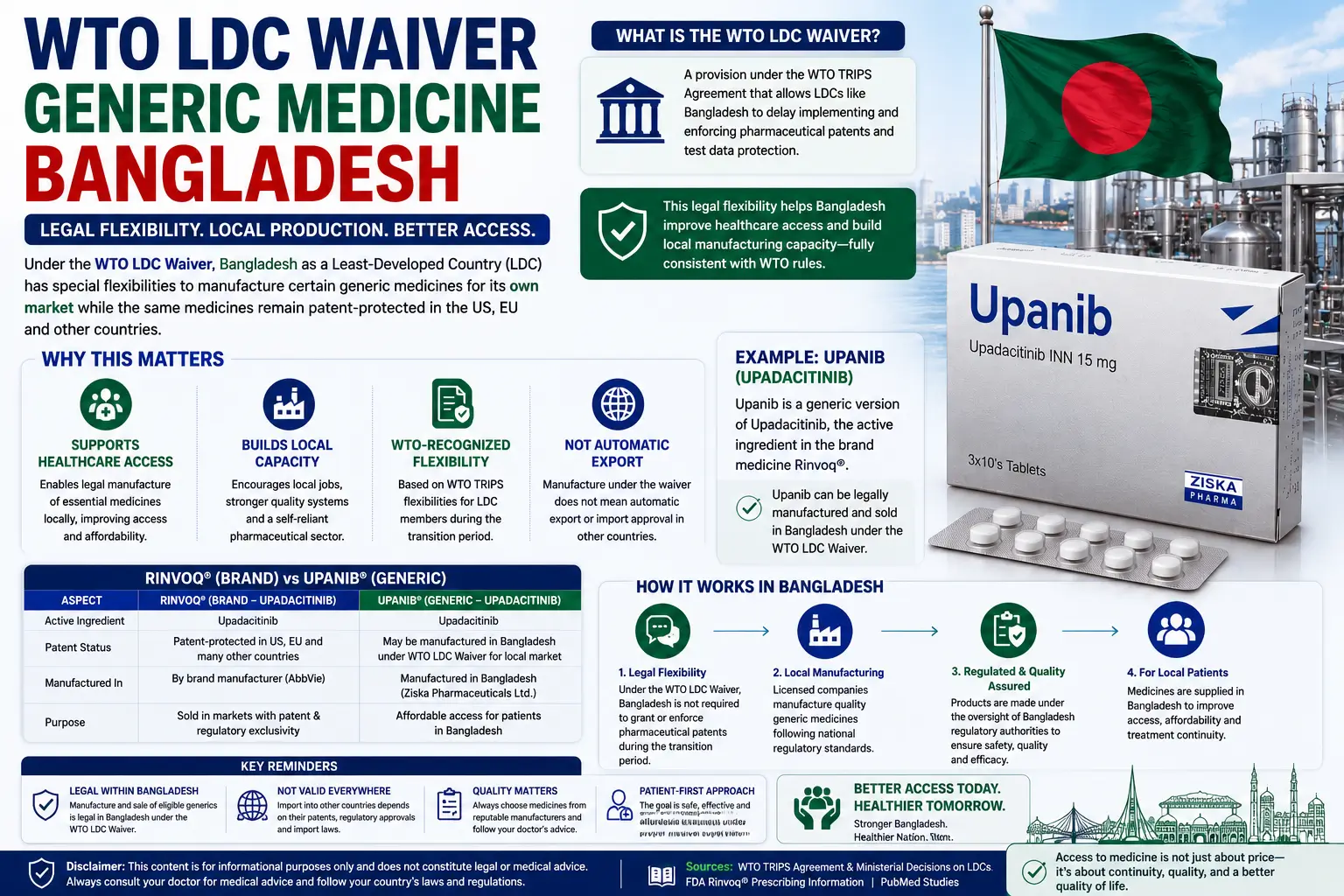
If you have ever wondered how some medicines can be made as lower-cost generics in one country while still being patent-protected elsewhere, the answer often comes back to the WTO LDC waiver generic medicine Bangladesh framework. Under the WTO LDC waiver generic medicine pathway, Bangladesh, as a least-developed country (LDC), has special flexibilities that can allow local production of certain generic medicines for its own market.
That is why, under the waiver generic medicine approach, a Bangladeshi company can legally manufacture generic versions of some patented drugs, even when those same products remain protected in the US or EU.
This article explains how the waiver works in plain language, what it does and does not allow, and why Bangladeshi products like Upanib (Upadacitinib) can be manufactured domestically under the WTO LDC waiver generic medicine system.
Table of Contents
Bangladesh’s legal pathway: The WTO LDC waiver in simple terms
The WTO LDC waiver generic medicine Bangladesh concept comes from the World Trade Organization’s TRIPS Agreement (Trade-Related Aspects of Intellectual Property Rights). TRIPS generally requires WTO members to provide patent protection for inventions, including pharmaceuticals. However, WTO members have long recognized that LDCs need more time and flexibility to build healthcare access and local capacity.
In practice, the WTO TRIPS waiver pharmaceuticals policy (often discussed as the LDC transition period and its extensions) allows an LDC to delay implementing or enforcing certain pharmaceutical patent obligations. The WTO has repeatedly extended the period during which LDC members are not required to provide or enforce pharmaceutical patents and certain protections for undisclosed test data for pharmaceuticals. These extensions are reflected in WTO decisions regarding TRIPS implementation for LDC members.
This is why the WTO LDC waiver generic medicine Bangladesh framework matters. Bangladesh can use these flexibilities to support local access to medicines, consistent with WTO rules. Many people refer to this as Bangladesh patent waiver drugs, but it is best understood as WTO-recognized TRIPS flexibilities for LDCs.
What this means for Upadacitinib
Upadacitinib is the active ingredient in AbbVie’s brand medicine RINVOQ. In the US and EU, RINVOQ has regulatory approvals and is associated with patent and exclusivity protections that can restrict generic entry in those markets.
So how can Bangladesh have a generic like Upanib? Under the WTO LDC waiver generic medicine Bangladesh structure, Bangladesh may legally allow domestic manufacture and sale of certain generics despite foreign patent status, because Bangladesh’s TRIPS obligations for pharmaceutical patents and test data protection are treated differently during the LDC transition period. That is the key legal logic behind is Upanib legal within Bangladesh when produced and marketed under Bangladeshi law and regulator oversight.
This point is important: the WTO LDC waiver generic medicine Bangladesh does not “cancel” patents in the US or EU. It affects what Bangladesh is required to do domestically during the LDC transition period.
Manufacturing under the waiver is not the same as automatic export or import approval
A common misunderstanding is assuming that the WTO LDC waiver generic medicine Bangladesh automatically makes a Bangladeshi generic eligible for sale everywhere. It does not.
The waiver primarily relates to what Bangladesh must do regarding patents and certain IP protections within Bangladesh as an LDC WTO member. Whether a medicine can be imported into another country depends on that country’s:
Patent status and enforcement, regulatory approval rules, and import laws.
So even if a medicine is produced legally in Bangladesh under the WTO LDC waiver generic medicine Bangladesh approach, another country may still prohibit importation if patents remain in force there, if the product lacks local regulatory approval, or if local rules limit personal importation.
This is where the patient-first takeaway matters. If you are exploring a medicine like Upanib, it is reasonable to ask not only “is Bangladesh generic medicine legal?” but also “Is it legal to import into my country, and does my regulator recognize the product?”
How this fits into Bangladesh’s generic drug manufacturing law
Bangladesh has a large pharmaceutical manufacturing sector and a long history of producing generics for the domestic market and for export to certain jurisdictions. The way Bangladesh applies TRIPS flexibilities interacts with local rules on licensing, quality systems, inspections, labeling, and distribution.
People searching for Bangladesh generic drug manufacturing law are usually trying to understand two separate issues:
First, whether Bangladesh can legally authorize domestic production under TRIPS flexibilities such as the WTO LDC waiver generic medicine Bangladesh. Second, whether the manufacturer follows recognized quality standards required by Bangladeshi regulators and, where relevant, by importing countries.
The waiver addresses the first issue. The second issue comes down to manufacturing quality systems, oversight, and compliance.
Why is Bangladesh generic medicine cheap?
Many readers also ask, why is Bangladesh generic medicine cheap? There is no single reason, and “cheap” can mean different things, but generally prices can be lower because generics competition reduces brand monopoly pricing, and because manufacturing and operating costs can be different from high-income markets. Local market dynamics, procurement practices, and supply chain factors can also affect price. Importantly, lower price does not automatically mean lower quality, but quality depends on the manufacturer and oversight.
Source: peer-reviewed discussions on generic competition and medicine pricing dynamics (for example, analyses indexed on PubMed regarding generic entry and price reductions in pharmaceutical markets).
This is another reason the WTO LDC waiver generic medicine Bangladesh is often discussed: it can enable earlier generic competition domestically, which may lower costs and expand access.
Upanib in Bangladesh: Legality and what patients should verify
To be precise about the question is Upanib legal, the most accurate answer is: a product like Upanib can be legal to manufacture and sell in Bangladesh under the WTO LDC waiver generic medicine Bangladesh framework and local regulation, even if the reference brand (RINVOQ) is patent-protected in other countries.
At the same time, it is worth separating three questions that often get blended together:
- Legal to manufacture in Bangladesh? This is where the WTO LDC waiver generic medicine Bangladesh and Bangladesh patent waiver drugs concepts are most relevant.
- Legal to import into another country? This depends on that country’s laws, patents, and regulatory approval.
- Appropriate for you clinically? This must be decided with a licensed clinician, considering indications, risks, and monitoring described in authoritative labeling such as the FDA label for RINVOQ (upadacitinib).
In other words, the WTO LDC waiver generic medicine Bangladesh is a legal and policy framework. It does not replace medical advice, nor does it override other countries’ legal requirements.
Ziska Pharmaceuticals Ltd. and cGMP compliance
Your outline also raises manufacturing standards. Ziska Pharmaceuticals Ltd. is referenced as the maker, and the phrase Upanib manufacturer Ziska Pharmaceuticals is often used by people trying to locate the source of the product.
When a company states it operates under cGMP (current Good Manufacturing Practice), it is generally referring to a quality system approach designed to ensure medicines are consistently produced and controlled to quality standards appropriate for their intended use. cGMP principles are widely recognized in global pharmaceutical manufacturing.
A patient-first way to interpret this is: cGMP claims are meaningful, but you should still look for specific, verifiable information such as certifications, audit summaries, regulator inspection information where available, and the company’s own published quality and compliance commitments. Under the WTO LDC waiver generic medicine Bangladesh, legal manufacture is one part of the story, while trustworthy quality systems are the other part patients care about.
The waiver’s scope, and why the details matter
The WTO LDC waiver generic medicine Bangladesh is sometimes described casually as “Bangladesh can make any patented drug.” That is an oversimplification.
What the waiver does is provide a WTO-recognized transition approach for LDCs related to pharmaceutical patent obligations and certain data protections. It supports public health goals and local capacity building, but it still sits alongside local regulation and international trade realities.
Also, the phrase WTO LDC waiver generic medicine Bangladesh is often used online to refer to the broader idea that Bangladesh can produce generics earlier than many other countries. That general idea is directionally correct, but the practical outcome for any specific product depends on how local law, regulatory decisions, and company actions line up.
Bottom line
The most practical summary is this: Bangladesh can legally manufacture certain generics under the WTO LDC waiver generic medicine Bangladesh framework, even when those medicines remain patent-protected in the US or EU. This explains how a product like Upanib may be produced for the Bangladeshi market. However, the waiver does not automatically grant permission to import into other countries, and quality and regulatory status should always be verified.
If you are researching WTO LDC waiver generic medicine Bangladesh, keep your focus on three checkpoints: legality of manufacture in Bangladesh, legality of import where you live, and evidence of quality standards such as cGMP-based systems.


