Rinvoq Boxed Warning Explained: Infection, Cancer, and Blood Clot Risk — What Every Patient Should Know Before Starting
16 Jul, 2026
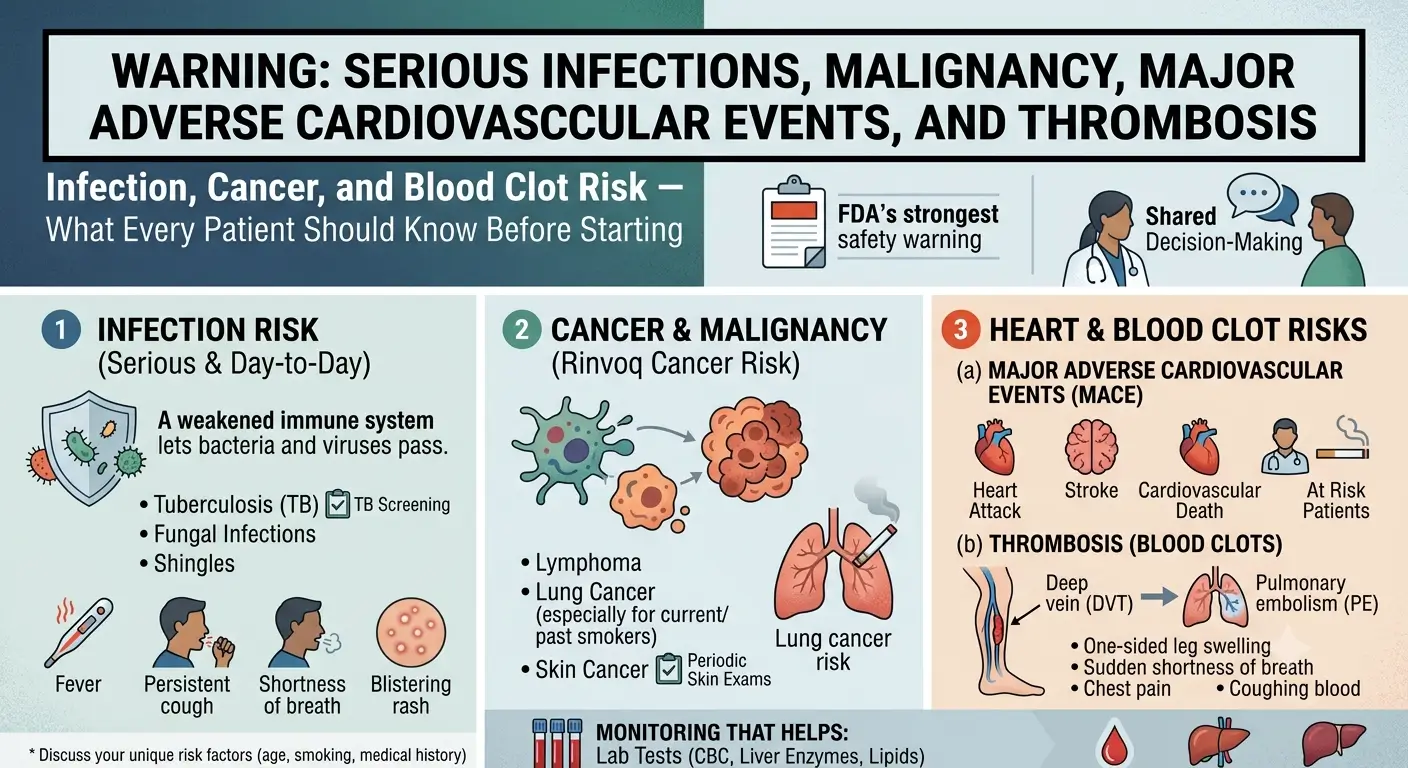
Table of Contents
Rinvoq Boxed Warning Explained: Infection, Cancer, and Blood Clot Risk — What Every Patient Should Know Before Starting
If you’re here because you searched “Rinvoq boxed warning explained”, you’re not alone. A boxed warning is the FDA’s strongest safety warning, and it exists to help patients and clinicians weigh benefits against serious risks. In this guide, I’ll keep the language plain, stick closely to FDA-approved prescribing information, and walk through what the warning means in real life, including infection risk, cancer risk, heart-related risks, and blood clots. By the end, you should feel more prepared to talk with your clinician about whether Rinvoq is right for you and what monitoring helps reduce harm.
To be crystal clear from the start, Rinvoq boxed warning explained does not mean “you should never take it.” It means the medicine has known serious risks that require careful screening, shared decision-making, and ongoing monitoring. Rinvoq (upadacitinib) is a prescription JAK inhibitor used for several inflammatory conditions. Some people may also encounter the brand Upanib (Upadacitinib) in certain markets; the safety concepts and boxed warning themes discussed here are the same class of concerns clinicians consider when prescribing upadacitinib products.
What a boxed warning is and why Rinvoq has one
A boxed warning (sometimes called a “black box warning”) is added when the FDA determines a drug has risks of serious or life-threatening adverse effects. With JAK inhibitors like upadacitinib, the FDA warning highlights increased risks of serious infections, malignancy, major adverse cardiovascular events, and thrombosis in certain patients.
So when you see Rinvoq boxed warning explained in a headline, what you’re really asking is: How likely are these risks for me, and what can I do to lower them? The most important part is your personal risk profile, including age, smoking history, cardiovascular disease, prior clotting events, cancer history, and infection exposure.
Sources: AbbVie RINVOQ
Serious infections: The biggest day-to-day risk clinicians watch for
The first major topic in any Rinvoq boxed warning explained discussion is serious infection. Rinvoq suppresses parts of the immune response, which can make it harder for your body to control infections. The FDA warning highlights serious and sometimes fatal infections, including tuberculosis (TB), bacterial infections, invasive fungal infections, and infections caused by opportunistic pathogens. In clinical practice, this is why clinicians ask about recurrent infections, recent antibiotic use, travel exposures, and whether you’ve had shingles before.
People can and do take Rinvoq safely, but Rinvoq risks are not theoretical. If you develop symptoms like persistent fever, shortness of breath, chest pain with breathing, coughing up blood, severe weakness, confusion, or a painful rash with blisters, you should seek medical attention promptly and tell the clinician you are taking a JAK inhibitor.
A practical takeaway from Rinvoq boxed warning explained is that prevention and early recognition matter. Before starting therapy, clinicians commonly review immunization status and evaluate infection risk. During treatment, they monitor for signs and symptoms of infection and may pause the drug if a serious infection occurs.
Tuberculosis (TB): Screening is not optional
Another key part of Rinvoq boxed warning explained is TB risk. The FDA labeling recommends evaluating patients for active and latent TB infection prior to starting Rinvoq, and monitoring for TB during treatment. If latent TB is found, treatment for latent TB should be started before initiating Rinvoq, consistent with clinical guidance.
TB can be silent for years, so you can feel well and still test positive for latent TB. That is why clinicians use a blood test (IGRA) or skin test (TST), plus additional assessment when needed.
Cancer and malignancy: understanding the “Rinvoq cancer risk warning”
When patients ask for Rinvoq boxed warning explained, the next question is often about cancer. The FDA boxed warning notes malignancies have occurred in patients treated with Rinvoq, including lymphoma and other cancers. The warning also highlights lung cancer risk in current or past smokers and an increased risk of non-melanoma skin cancers, which is why periodic skin examinations may be recommended for patients at increased risk.
It’s important to hear this in a balanced way. The risk is not identical for everyone. Your baseline risk matters, and so does your prior exposure to immunosuppressive therapy, your age, smoking history, and personal or family cancer history. If you have had cancer before, this should be a direct, specific conversation with your prescriber about alternatives, timing, and monitoring.
This is also where you may see searches like “is upadacitinib safe” and “upadacitinib side effects serious.” The most accurate answer is: safety is individualized, and the FDA warning exists precisely to guide patient selection and monitoring.
Sources: FDA RINVOQ Prescribing Information (Malignancy); peer-reviewed literature on JAK inhibitor safety signals including ORAL Surveillance informing class risk considerations (PubMed).
Heart-related risks: the JAK inhibitor cardiovascular risk clinicians take seriously
A central part of Rinvoq boxed warning explained is the warning about major adverse cardiovascular events (MACE), such as heart attack, stroke, and cardiovascular death. The FDA labeling emphasizes higher risk in patients who are current or past smokers and in those with cardiovascular risk factors.
This concern is often summarized online as JAK inhibitor cardiovascular risk. Practically, it means your clinician should consider your age, smoking status, blood pressure, diabetes, cholesterol, prior heart disease, prior stroke, and family history. It also means you should report new symptoms promptly, including chest pressure, sudden shortness of breath, weakness on one side, facial drooping, or trouble speaking.
If you already have established cardiovascular disease or multiple risk factors, this becomes a particularly important part of shared decision-making. Your clinician may discuss other therapy options, or proceed with closer monitoring and more aggressive management of modifiable risks (like smoking cessation, lipid control, and blood pressure management).
Blood clots (thrombosis): what “Rinvoq blood clot risk” means
Patients commonly search Rinvoq boxed warning explained because they’ve heard about clots. The FDA boxed warning includes thrombosis, including deep vein thrombosis (DVT), pulmonary embolism (PE), and arterial thrombosis, reported in patients treated with JAK inhibitors. Risk may be higher in certain populations.
So what does Rinvoq blood clot risk feel like in real life? DVT symptoms can include swelling, pain, tenderness, warmth, or redness in a leg (often one-sided). PE symptoms can include sudden shortness of breath, chest pain that worsens with deep breathing, rapid heart rate, dizziness, or coughing up blood. These can be emergencies.
If you have a history of blood clots, clotting disorders, prolonged immobility, recent major surgery, cancer, estrogen therapy, or strong cardiovascular risk factors, your prescriber should weigh these carefully. This is a “high-stakes” part of Rinvoq boxed warning explained, and it’s also why you should not ignore new swelling or unexplained shortness of breath during treatment.
Who is considered “high risk” and should pause before starting?
One of the most useful ways to apply Rinvoq boxed warning explained is to identify whether you fall into a higher-risk category. You should specifically discuss risks and alternatives if you are:
- Age 50 or older with at least one cardiovascular risk factor (especially if you are a current or past smoker)
- A current or past smoker (higher risk for MACE and certain cancers is emphasized in FDA warnings for this class)
- Someone with a history of blood clots, heart attack, or stroke
- Someone with recurrent infections, chronic lung disease, diabetes, or a history of TB exposure
- Someone with a prior malignancy or high skin cancer risk
This does not automatically rule out treatment, but it raises the importance of individualized counseling about Rinvoq risks, plus tighter follow-up plans.
Monitoring that helps catch problems early (blood counts, liver, and lipids)
A practical Rinvoq boxed warning explained conversation should always include monitoring. The FDA-approved labeling describes laboratory monitoring related to changes in blood counts, liver enzymes, and lipids. Your prescriber may order baseline tests and repeat them after starting, then periodically.
Monitoring commonly includes:
- Complete blood count (CBC) to watch for changes in white cells, red cells, and platelets
- Liver enzymes (ALT/AST) for liver-related effects
- Lipid panel (cholesterol and triglycerides), since JAK inhibitors can increase lipids
If you have symptoms such as unusual bruising, severe fatigue, yellowing of skin or eyes, dark urine, or persistent nausea, report them promptly because they can overlap with liver or blood-related problems. This is also part of why people search upadacitinib side effects serious and Upanib side effects warning; the answer is that labs and symptoms together guide safe use.
Contraindications: None” is not the same as “no serious risks
You may notice some references that say “Contraindications: None.” That statement can be misread. It does not mean there are no serious safety concerns. It means the FDA labeling does not list absolute situations where the drug must never be used. Instead, Rinvoq relies heavily on warnings, precautions, patient selection, and monitoring.
So if you saw a “Contraindications: None” line and thought it conflicts with the boxed warning, this is the consistent explanation: Rinvoq boxed warning explained exists because serious adverse outcomes can occur, even without formal contraindications. This is particularly relevant given that serious adverse events can sometimes arise from unforeseen factors. The label directs clinicians on screening and risk mitigation.
Putting it all together: What to discuss with your clinician before day 1
If you want a quick checklist to bring to your appointment, here are the most useful topics that come directly out of Rinvoq boxed warning explained and the FDA label: your infection history and TB risk, your smoking status, prior clots, prior cancer, heart and stroke risk factors, current medications (especially other immunosuppressants), and your plan for lab monitoring.
If you and your clinician decide to proceed, ask for a clear written schedule for labs and follow-ups, plus guidance on what symptoms should trigger an urgent call. And if you are reading about Upanib, remember that Upanib contains upadacitinib; the same class-level safety discussions apply, including Upanib side effects warning considerations that mirror boxed warning themes.
Before you start, it helps to review the practical details, especially dosing instructions and the exact monitoring schedule your prescriber prefers. If you’re ready, go next to the dosage and monitoring section and use it as your appointment prep.


